Principle Lab
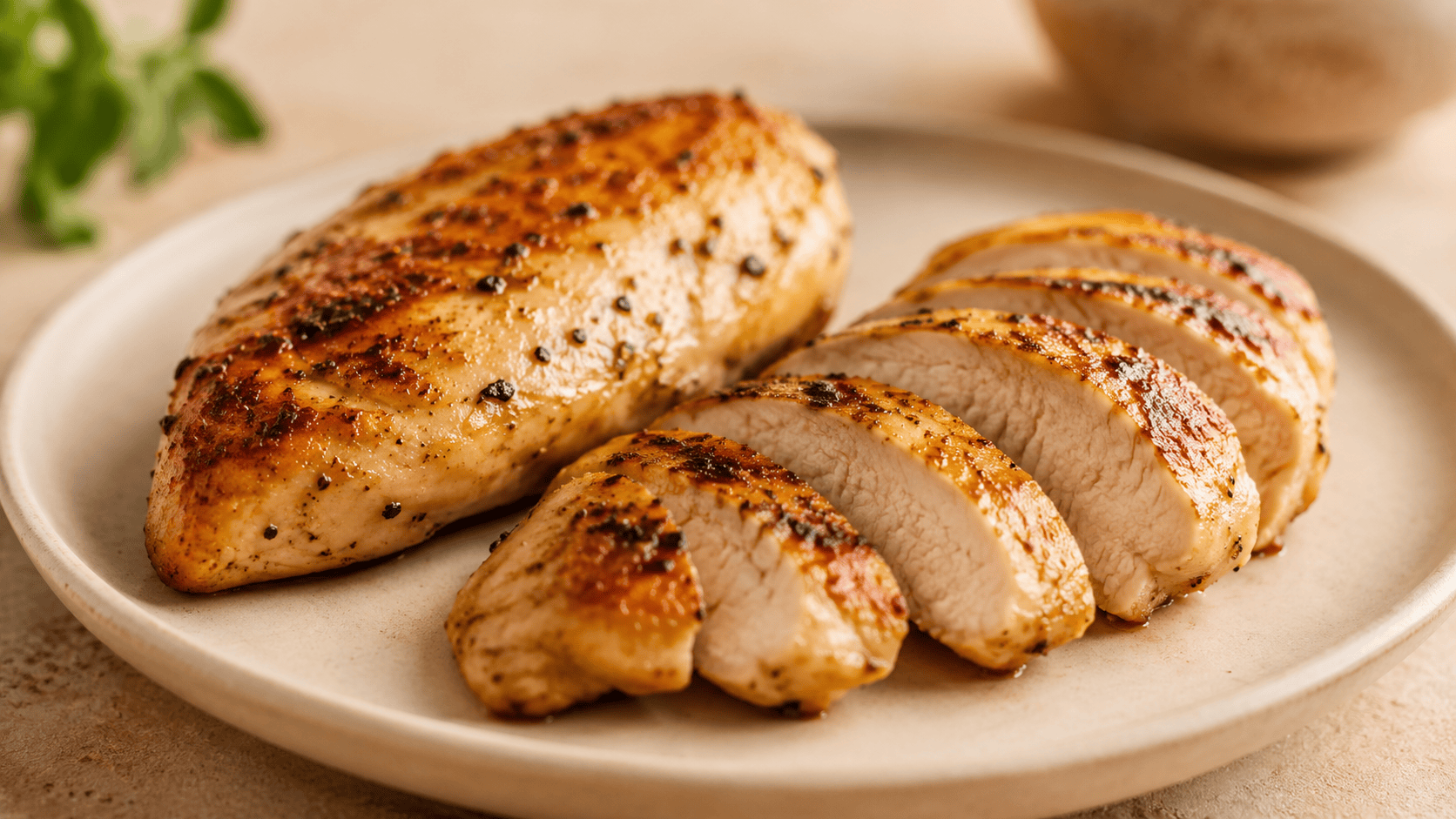
Pan-Seared Chicken Breast
Jump to Recipe ↓The Principle
Carryover cooking: food keeps cooking after it leaves the heat. Pull your chicken 5 to 10°F early, let it rest, and the center finishes on its own. No dry chicken. No guesswork.
What You Need
Structure
- 2 boneless skinless chicken breasts (6 to 8 oz each. If thicker than 1 inch, pound to even thickness.)
The Sear
- 1 tbsp neutral oil (avocado or canola)
- 1/2 tsp kosher salt
Flavor Support
- Fresh cracked black pepper (after cooking)
- 1 garlic clove, smashed
- Fresh thyme sprigs
Method
-
Pat chicken completely dry. Salt both sides. Let sit at room temperature for 10 to 15 minutes.
WhySurface moisture boils at 212°F. Maillard browning needs roughly 280°F. Every drop of surface water must boil off before browning starts. Dry meat equals a better crust. The short rest takes the chill off for more even cooking.
-
Heat a heavy pan (cast iron or stainless) over medium-high. Add oil. Wait for the shimmer.
WhyShimmer is roughly 350°F for most oils. Hot enough for Maillard without burning the oil. Smoke means the oil is breaking down into bitter compounds.
-
Place chicken in the pan. Don't touch it for 5 to 6 minutes. Flip once.
WhySustained contact with the hot surface builds the crust. Moving the chicken interrupts browning. One flip is enough if the pan is properly heated.
-
Cook the second side for 3 to 4 minutes. Check the temperature in the thickest part. Pull at 155°F.
WhyThis is the key. 155°F is the pull point, not 165°F. The chicken will carry over another 5 to 10°F while resting. If you wait until 165°F in the pan, you're eating 170 to 175°F. Dry. At 155°F held for roughly 50 seconds, chicken is pasteurized and safe.
-
Rest on a warm plate, tented loosely with foil. 5 to 7 minutes. Slice against the grain.
WhyResting lets protein fibers relax and reabsorb moisture. Cut immediately and the juice floods the board. Wait and it stays in the meat.
What Can Go Wrong
Dry chicken?
You pulled too late. Carryover cooking adds 5 to 10°F after the pan.
Pull at 155°F. Not 165°F.
No crust?
The meat wasn't dry, or the pan wasn't hot enough.
Pat it bone-dry. Wait for the shimmer.
Pink center?
Color isn't a reliable doneness indicator. Myoglobin can stay pink even at safe temperatures.
Trust the thermometer, not the color. 155°F held for roughly 50 seconds is pasteurized.
The Science Behind This Recipe
Cook This Next
You cooked your chicken to 165°F. You did everything right. And it was dry.
This is the most frustrating thing about cooking chicken breast. You follow the rule that 165°F means safe, and you get a dry, chalky result that needs a sauce to rescue it. You did what every food safety guide tells you to do, and the chicken punished you for it.
The rule isn’t wrong. It’s incomplete. The USDA’s 165°F recommendation is the temperature at which salmonella is killed instantly in one second. It’s a one-size-fits-all number designed for clarity, not quality. But pasteurization is a function of both temperature and time. At 155°F, chicken is safe after roughly 50 seconds. And here’s the part most guides skip: the interior keeps climbing after you pull it from the pan.
That’s carryover cooking. The outer layers of the chicken are hotter than the center when it leaves the heat. That energy doesn’t vanish. It travels inward. If you pull at 165°F, the center hits 170 to 175°F before it stops climbing. That’s the difference between juicy and chalky.
The fix is simple: pull at 155°F and let the chicken finish itself.
Before You Start
Read Searing Does Not Lock in Juices to understand what the crust actually does. It’s flavor, not a moisture seal. The crust is Maillard chemistry. The juiciness comes from carryover cooking and resting.
Read Why Resting Meat Works for the full explanation of what happens inside the protein fibers when meat rests. Cutting early isn’t just messy. It’s a moisture loss you can’t get back.
Read Why Oil Shimmers Before It Smokes to understand the signal you’re waiting for at the pan. Shimmer means go. Smoke means start over.
Once you understand those three principles, you’ll never serve dry chicken again. You’ll pull early, you’ll rest, and you’ll wonder why every recipe doesn’t tell you this.
Better cooking starts
with understanding.
One cooking problem at a time, explained clearly.
Follow @betterbitelab