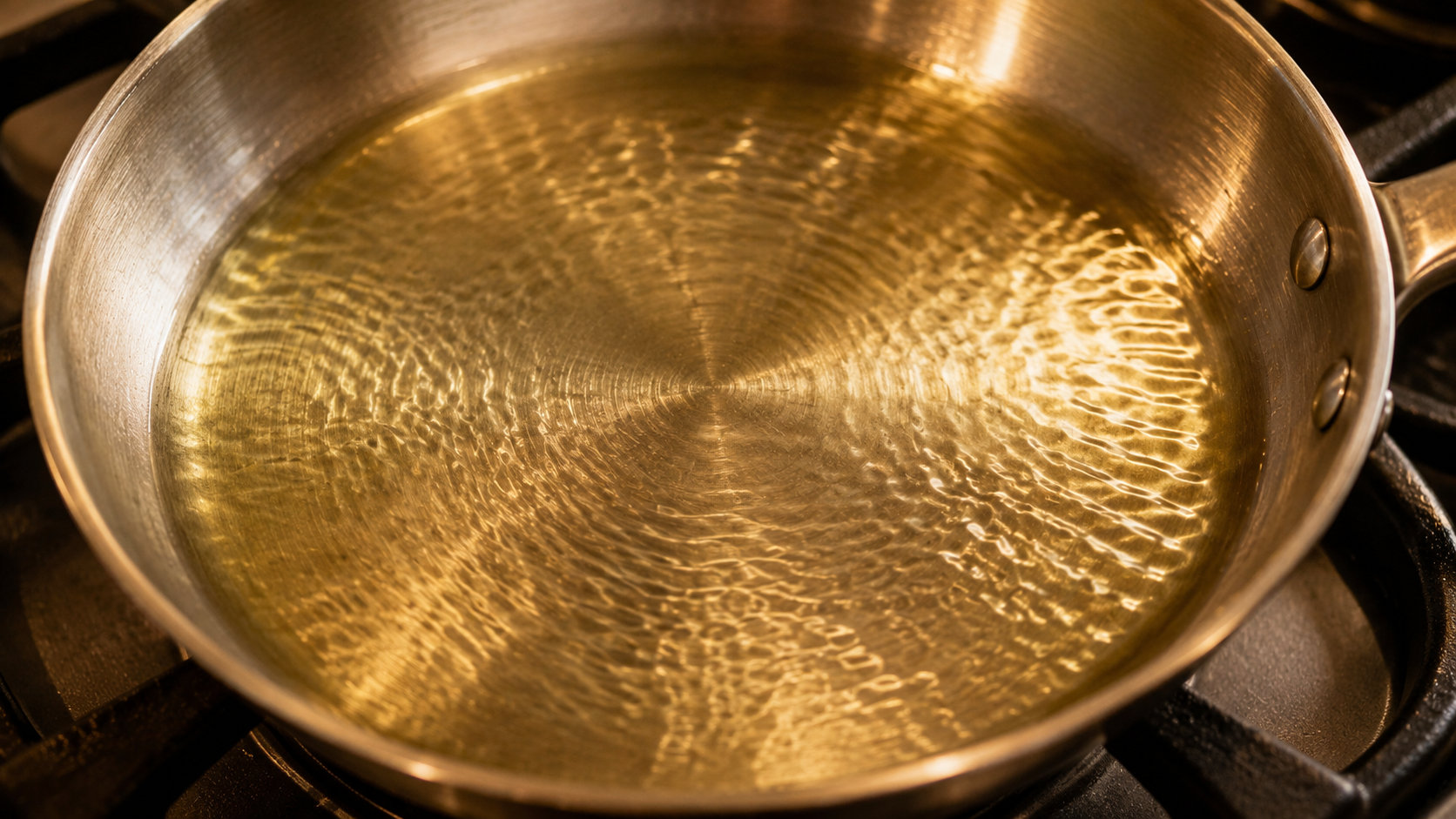
You’re standing over the stove, staring at a pan of oil. The recipe said “heat until shimmering.” You’re wondering what that actually means. You’re also wondering whether you should just wait for the smoke.
Don’t.
The shimmer is your signal. Smoke is your mistake. Here is why, what’s happening in the pan, and how to catch that perfect moment every time.
What the Shimmer Actually Is
The shimmer is not some mystical cooking intuition. It’s a physical effect you can see and understand.
Cold oil is thick. Its viscosity is high, meaning the molecules resist flowing past each other. As oil heats, its viscosity drops sharply. The oil becomes thinner, more fluid, more mobile.
At roughly 325°F to 350°F for most cooking oils, something visible happens. Convection currents form inside the oil: hotter oil at the bottom rises, cooler oil at the surface sinks, and the whole thing starts circulating. These currents create subtle ripples and waves on the surface. Light catches those ripples at different angles. The oil appears to shimmer, like heat waves over asphalt on a summer day.
That shimmer is moving oil. It’s telling you the pan is evenly hot, the oil is fully up to temperature, and the surface is ready to receive food.
The Temperature You’re Actually Looking For
The shimmer matters because it sits in a temperature sweet spot.
The Maillard reaction — the chemical process that creates browning and the deep, savory flavors you want in seared food — kicks in around 280°F and runs strong through about 330°F. Below that, you are not browning anything. You are steaming.
The shimmer happens right as your oil crosses into this zone. Most neutral oils shimmer between 325°F and 350°F. That is hot enough for browning to begin the instant food hits the pan, but not so hot that the oil is breaking down.
You’re not waiting for the oil to “get hot enough.” You’re waiting for the surface to cross one specific threshold. The shimmer tells you exactly when that threshold is met.
Why Smoke Means You Missed It
When oil smokes, something bad is happening.
Smoke is a chemical breakdown. The oil’s triglycerides are splitting into free fatty acids and glycerol. The glycerol is further decomposing into acrolein — a sharp, irritating compound that makes your eyes sting and your kitchen smell like a mistake.
Those compounds taste bitter. They taste acrid. They taste like the burnt corner of something you should have pulled off the heat 30 seconds earlier. And once the oil has started smoking, those flavors are in the pan and heading into your food.
The shimmer is your green light. Smoke is the red light. You want to be in the gap between them.
Different Oils, Different Rules
Not all oils shimmer at the same temperature. Not all oils smoke at the same temperature either. The gap between shimmer and smoke varies.
- Butter — smokes around 350°F. Its shimmer window is tiny, maybe 10 to 15 seconds. It goes from ready to burnt fast. Watch it closely. Clarified butter buys you more room, smoking closer to 450°F.
- Olive oil — smokes around 375°F for standard refined olive oil, lower for extra virgin. Fine for moderate-heat searing. Not your first choice for a ripping-hot steak sear.
- Canola and vegetable oils — smoke around 400°F. A comfortable window. Good all-purpose choices for pan-searing.
- Avocado oil — smokes around 520°F. The widest window of any common cooking oil. Nearly impossible to accidentally smoke on a home stove unless you walk away and forget the pan entirely.
Pick your oil based on how hot you need to go. For a hard sear on a steak, reach for avocado. For a gentler saute, olive oil or butter will do. But whatever oil you choose, the rule is the same: shimmer is go, smoke is too far.
The Water Drop Test
If you’re not confident reading the shimmer yet, use a single drop of water.
Flick one drop — one drop, not a splash — into the hot oil. If it sizzles gently and evaporates in under a second, the pan is ready. If the water pops violently, spatters oil everywhere, and sounds aggressive, the pan is too hot. If the water just sits there and fizzles slowly, the pan isn’t hot enough yet.
This is a training tool. You don’t need it forever. Once you learn to read the shimmer, you’ll stop reaching for the water entirely.
The Window Is Real, and It’s Short
The time between shimmer and smoke is roughly 30 to 60 seconds, depending on your oil and your heat source. Gas burners on high can close that window fast. Electric stoves with residual heat can keep pushing the temperature even after you lower the flame.
This means you should have your food ready before the oil hits the shimmer. Not chopping. Not scrambling to find the tongs. Ready. The window doesn’t wait.
Why Any of This Matters
The home cook who heats the pan, adds oil, and immediately drops in food is cooking cold. The surface temperature plummets on contact, the oil never reached browning temperature, and the food releases moisture into a lukewarm pan. The result is steamed, pale, sad.
The home cook who waits until the oil is billowing smoke has crossed the line. The oil is breaking down. Acrid, burnt flavors are forming. The food will sear, but it will also taste faintly of mistakes.
The home cook who catches the shimmer gets it right. The pan is hot enough for browning the instant food hits. The oil is intact. The window is open. That is the difference between food that tastes properly cooked and food that tastes like you got distracted.
Your Pan Signal Checklist
- Choose the right oil for your heat level. Higher heat needs a higher smoke point.
- Preheat the pan dry. Add oil to a hot pan, not a cold one.
- Watch for the surface to ripple — thin, shifting lines like heat waves.
- If you see the first wisp of smoke, pull the pan off the heat for 10 seconds. You’re still okay. Billowing smoke means start over.
- Have your food ready before the shimmer hits. The window does not wait for you.
Cook the Principle
Cook the Principle
Put this into practice.
Pan-Seared Chicken Breast — 25 min · Beginner
That shimmer is a 30-second signal. Learn to read it, and you’ll never wonder whether your pan is ready again.