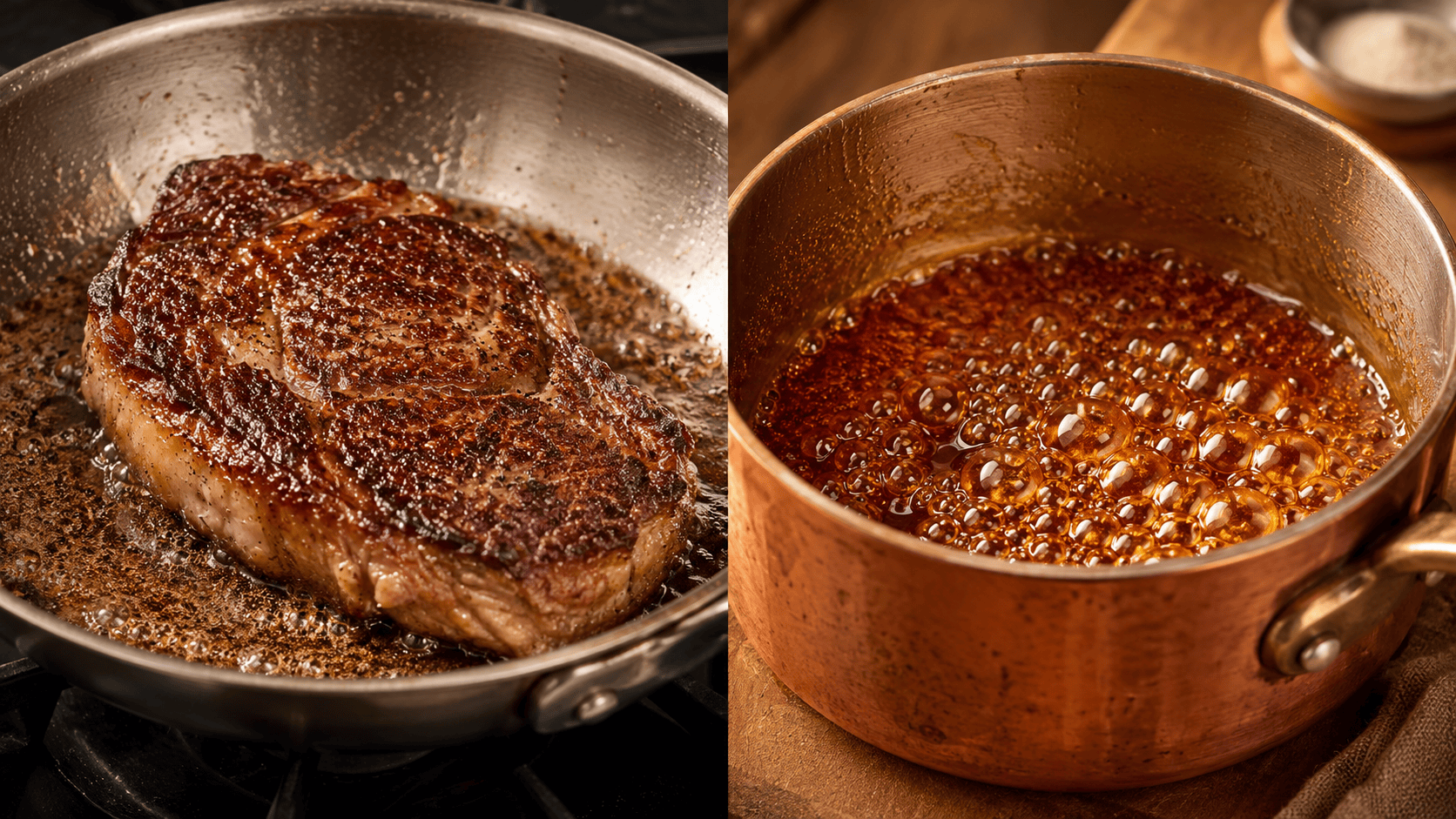
You’ve heard that brown food tastes better. You might know the word Maillard. Maybe you’ve used it in conversation. But the deep brown crust on your steak and the golden brown on your caramelized onions come from two completely different chemical reactions. Knowing which is which changes how you cook both.
The Maillard reaction needs three things: amino acids (from protein), reducing sugars, and heat above roughly 280°F. When a steak hits a hot pan, the proteins and trace sugars on the surface react to form hundreds of new flavor compounds. Savory, meaty, roasted notes. This is why seared food tastes fundamentally different from boiled food, even if both reach the same internal temperature. Maillard is also why toast tastes different from bread, why coffee beans are roasted, and why the crust on bread is darker and more flavorful than the interior.
Caramelization needs only one thing: sugar plus heat above roughly 320°F. No protein required. When sugar hits that temperature, the molecules break apart and re-form into darker, more complex compounds with sweet-bitter notes. Caramelization is what turns white sugar into amber caramel, what browns onions after 30 minutes of patient heat, and what gives dulce de leche its color and depth.
They often happen simultaneously. A searing steak triggers Maillard on the meat surface and mild caramelization of any trace sugars present. A roasting sweet potato gets both. Caramelizing onions are pure caramelization. Toasted bread is pure Maillard. The difference matters because the conditions that optimize each reaction are different.
Maillard needs a dry surface. Any surface moisture must boil off at 212°F before the meat can reach the 280°F Maillard threshold. That’s why you pat steak dry. Caramelization needs patience. Sugar browns slowly and burns fast. The window between golden caramel and bitter black carbon is narrow.
The short version: Maillard is protein plus sugar plus heat. Caramelization is just sugar plus heat. Both make brown food. Both make better flavor. But they’re not the same thing, and treating them as interchangeable leads to mistakes in the kitchen.
Cook the Principle
Put this into practice.
Garlic-Infused Pan Oil. 10 min. Beginner