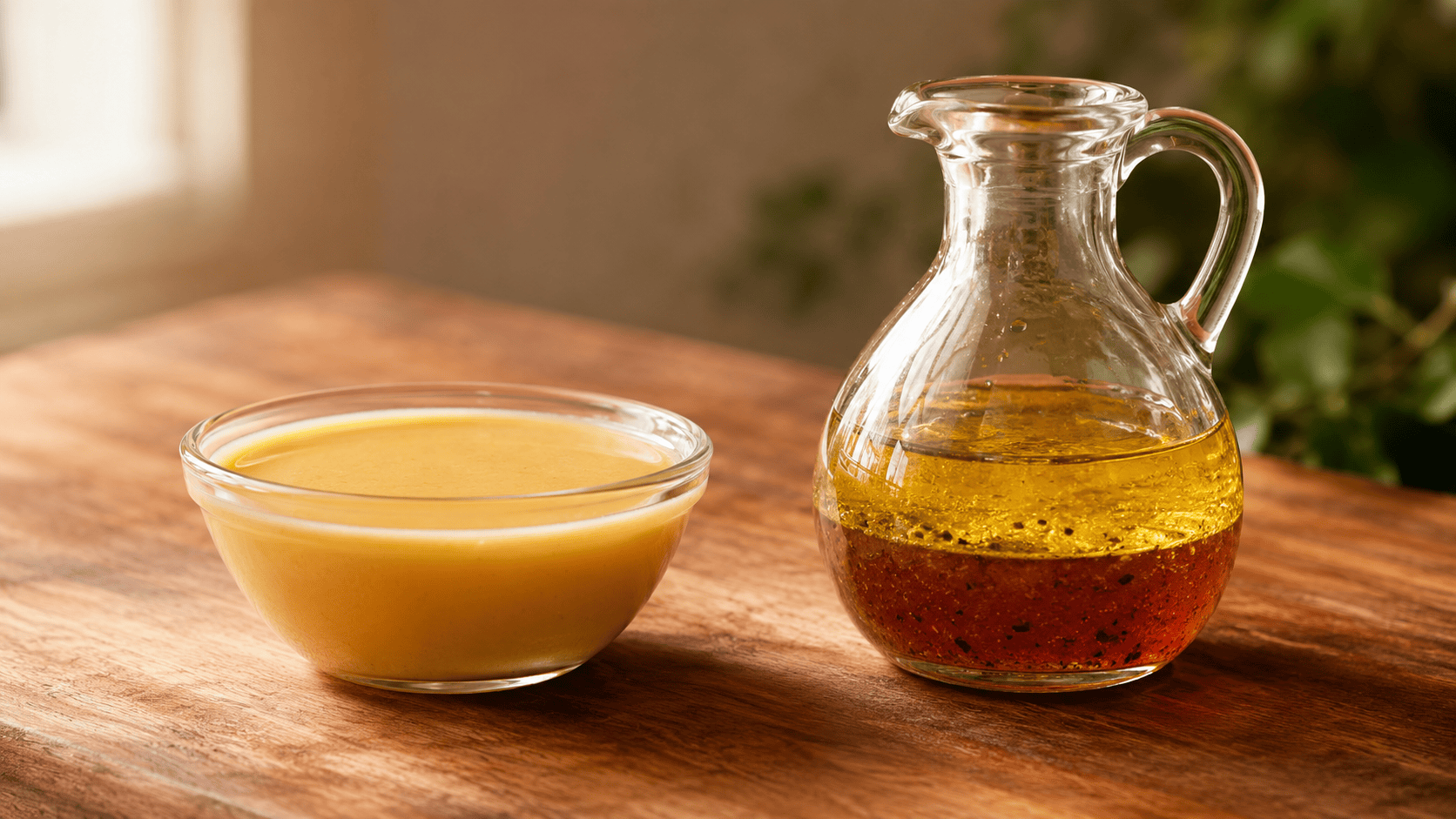
You whisked oil and vinegar together. It looked beautiful for 30 seconds. You turned to grab the salt, looked back, and it had separated into two distinct layers like a failed science experiment.
The problem isn’t your whisking technique. It’s not that you didn’t whisk fast enough. It’s that you’re fighting physics without an emulsifier. Oil and vinegar don’t mix because they can’t mix. Not on their own.
Oil is non-polar. Vinegar is polar. Think of polar molecules like magnets with a north and south end. Water (and vinegar, which is mostly water) is strongly polar. Each water molecule has a slightly positive side and a slightly negative side. They stick to each other like magnets. Oil molecules are electrically neutral all the way around. They have nothing for water to grab onto.
When you whisk oil into vinegar, you’re physically breaking the oil into tiny droplets. But those droplets are still non-polar. They’re still surrounded by polar water molecules that want nothing to do with them. So the droplets find each other, merge, and float back to the top. That’s a broken vinaigrette.
An emulsifier is a molecule with split loyalties. One end is polar and grabs water. The other end is non-polar and grabs oil. It wraps around each oil droplet like a protective coating, polar side out, and keeps the droplets from merging. Mustard contains lecithin. Egg yolks contain lecithin. That’s why both turn a vinaigrette from temporary to stable.
The other variable is droplet size. The smaller the oil droplets, the more stable the emulsion. Adding oil slowly while whisking constantly creates smaller droplets than dumping it in all at once. A fast pour creates large droplets that merge quickly. A slow drizzle creates tiny ones that stay suspended.
The short version: Mustard plus slow drizzle plus constant whisking equals a vinaigrette that stays together. Skip any one of those and you’re fighting physics without the right tools.
Cook the Principle
Put this into practice.
Shimmer-Test Vinaigrette. 5 min. Beginner