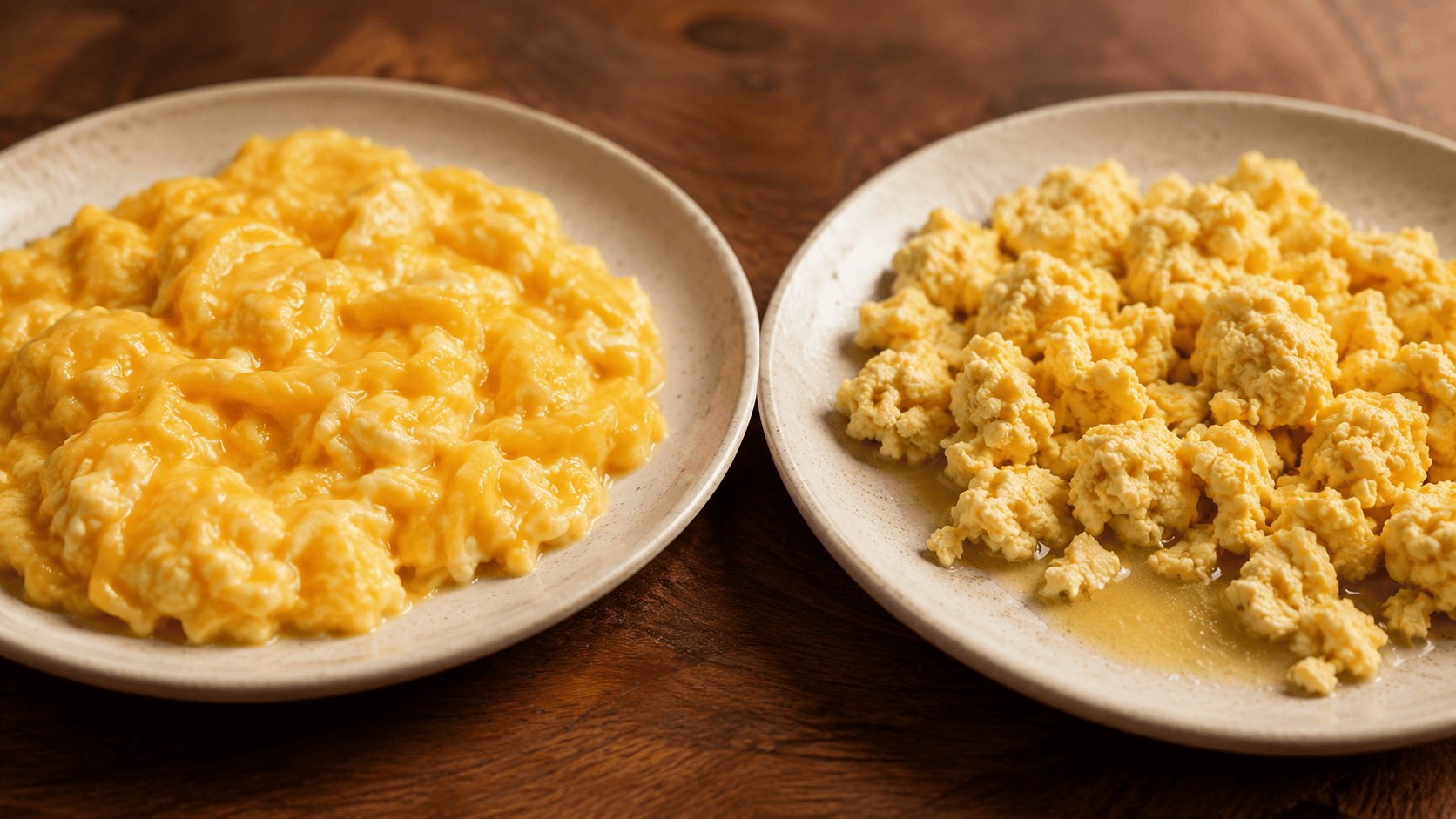
You used low heat. You stirred the whole time. You did everything the gentle-scramble tutorials told you to do. And your eggs still came out dry, rubbery, with a pool of watery liquid on the plate.
The problem isn’t your heat setting. It’s not your pan. It’s that you don’t know what temperature your egg proteins set at and which ones you’re trying to avoid.
Egg white contains several proteins, but two matter most for texture. Ovotransferrin begins to coagulate around 145°F. This is the creamy stage. The eggs are set but tender, the curds are soft, and the texture is custard-like. Ovalbumin doesn’t coagulate until roughly 180°F. This is the rubbery stage. The protein network tightens, squeezes out water, and turns what was creamy into something you could bounce.
That pool of water on the plate is called syneresis. It’s what happens when you push egg proteins past 180°F. The tightly coiled protein network physically squeezes water out of the curds. The more you overcook, the more water you lose. Low heat helps because it takes longer to reach 180°F, but time alone doesn’t save you. If the eggs eventually hit 180°F, they’ll be rubbery regardless of how gently you got them there.
The fix is the same as carryover cooking for meat. Pull the eggs before they look done. When they’re still glossy, slightly wet-looking, and the curds have formed but aren’t dry, that’s roughly 150 to 155°F. The residual heat in the eggs and the pan will carry them to perfect doneness on the plate.
The short version: Pull scrambled eggs when they still look underdone. They’ll finish on the plate. If they look done in the pan, they’ll be dry when you eat them.
Cook the Principle
Put this into practice.
Soft-Scrambled Eggs. 7 min. Beginner