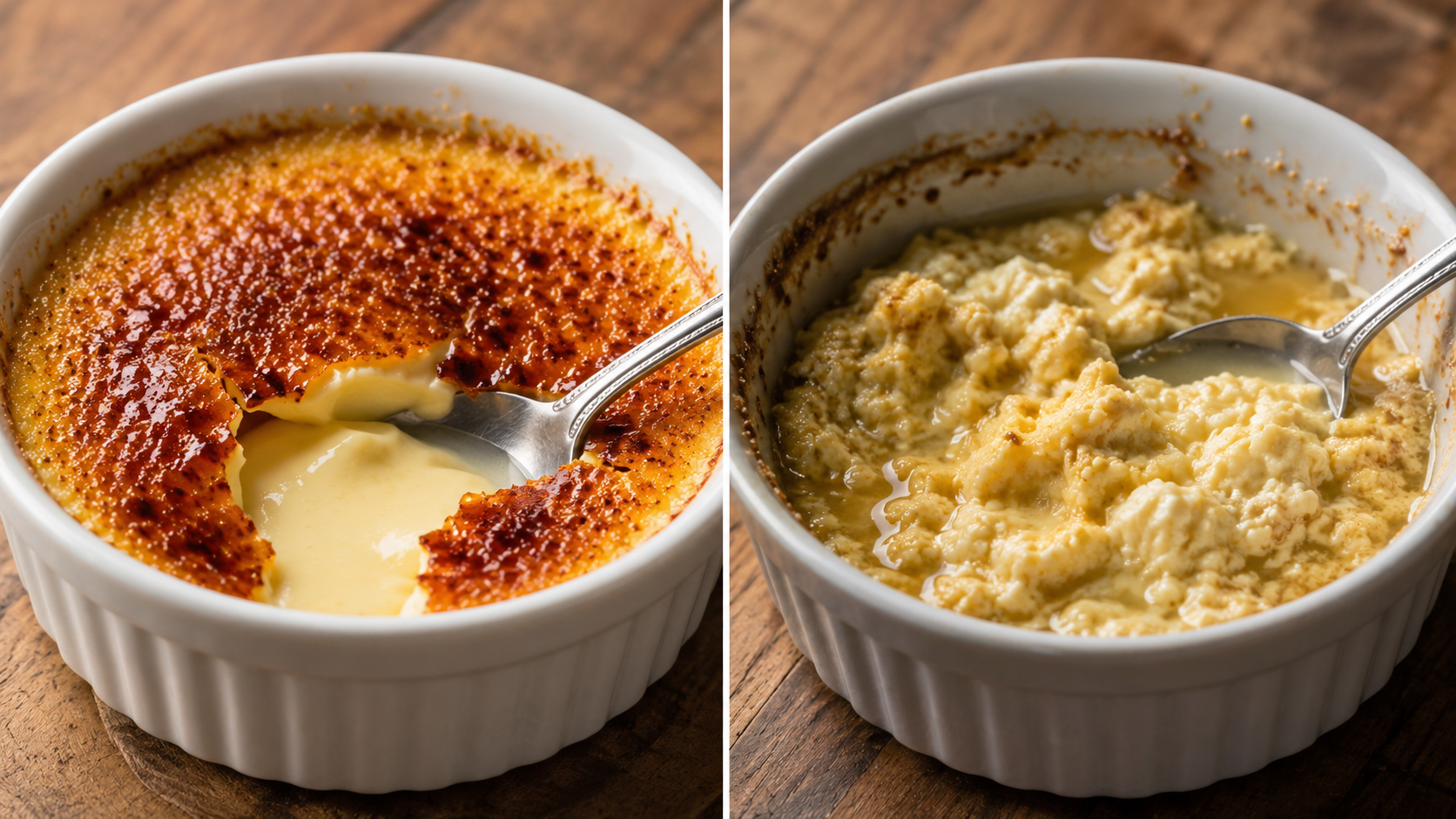
You put egg yolks, cream, and sugar in a dish. You baked it at 325°F like the recipe said. You pulled it out expecting silky custard. You got sweet scrambled eggs.
The problem isn’t your oven temperature. It’s that you don’t know the three temperature zones where egg proteins do completely different things.
The 15-Degree Window
Egg proteins don’t have one setting temperature. They have a range. And it’s narrower than you think.
150°F. The yolk proteins begin to unwind. They’re starting to thicken but haven’t set. At this point the custard is still liquid.
160-170°F. The window. The proteins have uncoiled enough to form a delicate three-dimensional gel that traps water and fat. The custard is set but tender. A spoon stands up in it. This is crème brûlée.
180°F. The proteins have tightened too far. They squeeze out the water they were holding — that’s the watery liquid pooling around your grainy custard, a process called syneresis. The protein network has collapsed from silk into a sponge, and no amount of cooling will un-sponge it.
The gap between perfect custard and scrambled eggs is roughly 15 degrees. Your oven at 325°F doesn’t care about that gap. It’ll push right through it.
Why a Water Bath Actually Works
The water bath isn’t fussy French technique for the sake of it. It’s a thermal governor.
Water at sea level cannot exceed 212°F. No matter how hot your oven is, the water in the bath stays at or below 212°F. The custard inside the ramekins, surrounded by that water, settles into the 160-170°F sweet spot where egg proteins set into gel without over-coagulating.
Without the water bath, the edges of the ramekin get direct oven heat. They hit 180°F while the center is still liquid. You get a ring of scrambled egg around a pool of uncooked custard. With the bath, the entire custard rises through the temperature gradient together and stops at the ceiling the water creates.
The depth matters too. The water should come halfway up the sides of the ramekins. Too shallow and the tops overheat. The water is doing the work — give it enough contact area.
Tempering: The Step Most People Skip
Before the custard even reaches the oven, there’s another way to scramble it. If you pour hot cream directly into egg yolks, the yolks hit 180°F instantly where the stream lands. You’ll see strands of cooked egg before you’ve even whisked.
Tempering fixes this. Pour a small amount of the hot cream into the yolks in a thin stream while whisking constantly. This raises the yolk temperature gradually — from fridge-cold to warm without ever crossing the coagulation threshold. Once the yolks are warm, they can take the rest of the hot cream without scrambling.
Straining the finished custard through a fine-mesh sieve catches whatever tiny strands did form. Even perfect tempering produces a few. The sieve is insurance.
The Jiggle Test
A thermometer in custard is awkward. The jiggle test is more reliable.
Gently shake the ramekin. The custard should wobble as one connected mass — like Jell-O. If it ripples in concentric rings like a stone dropped in water, it’s still liquid in the center. Give it five more minutes.
If it doesn’t move at all, you’re already past the window. It’ll still taste good, but the texture will be firm, not silky.
When in doubt, pull earlier. Custard carries over as it cools. The ramekins come out of a 325°F oven holding residual heat. Removing them from the water bath immediately stops that carryover. Leaving them in hot water means they keep cooking.
The Short Version
Egg proteins set into silk at 160-170°F. They scramble at 180°F. The water bath is the only thing standing between those two numbers.
Temper the yolks. Fill the bath halfway. Pull when it jiggles like Jell-O, not when it’s firm. Remove from the water immediately.
The difference between crème brûlée and sweet scrambled eggs is 15 degrees and a pan of hot water. Now you control both.
Cook the Principle
Put this into practice.
Crème Brûlée. 1 hour. Intermediate