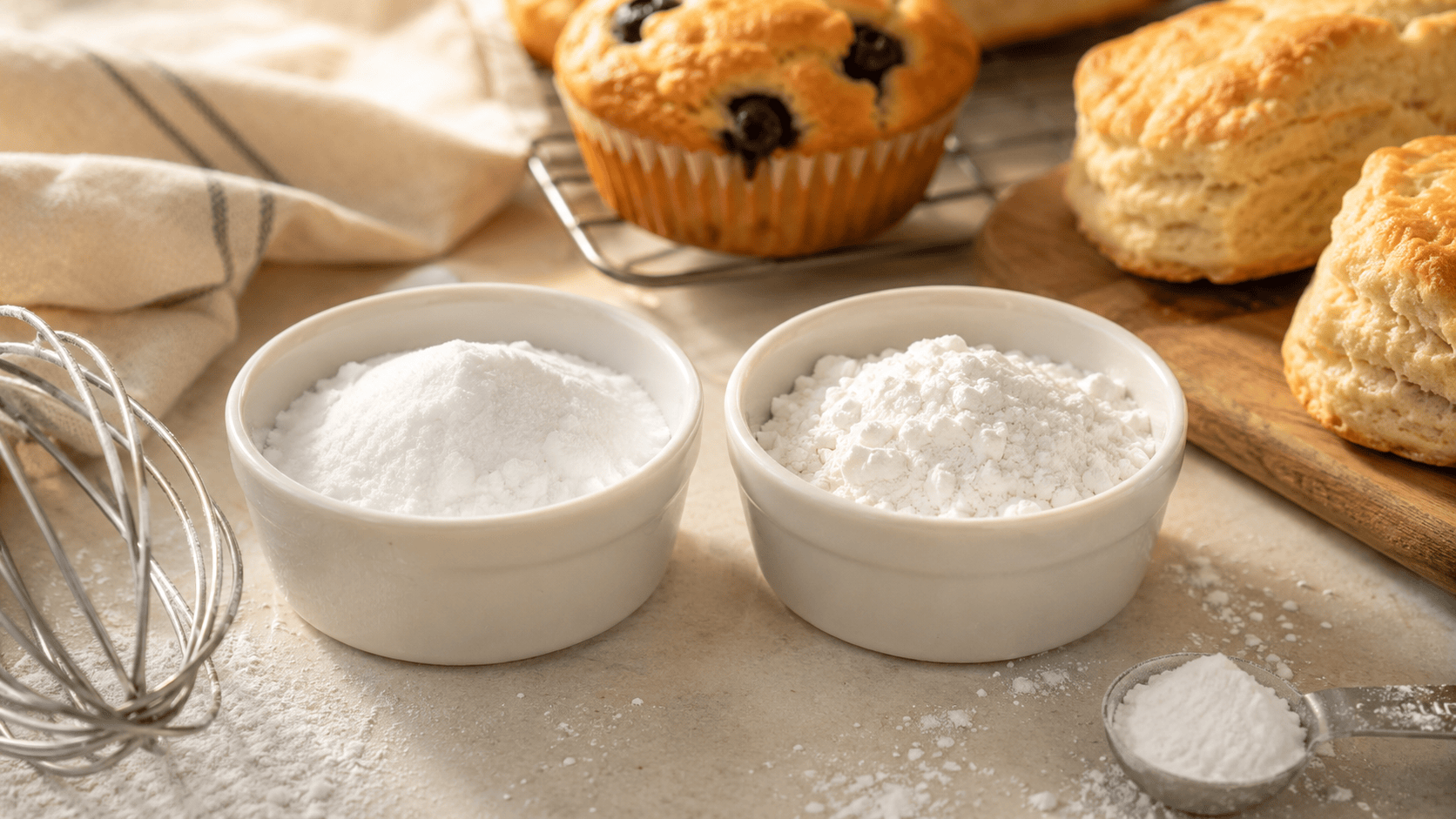
You’ve done it. Standing in the kitchen, recipe in one hand, two nearly identical boxes in the other. You grabbed one. It was the wrong one.
Your muffins came out flat. Your cake tasted metallic. Your pancakes didn’t rise.
Baking soda and baking powder look the same. They’re not. And swapping them is one of the most common baking mistakes people make.
What Baking Soda Actually Is
Baking soda is a single chemical: sodium bicarbonate. That’s all it is.
When sodium bicarbonate meets an acid and a liquid, it produces carbon dioxide bubbles. Those bubbles are what make your baked goods rise.
But here’s the catch: baking soda needs acid to work. Without acid in your batter or dough, nothing happens. No bubbles. No rise. Just a dense, disappointing result with a metallic aftertaste from unreacted soda.
That’s why recipes that call for baking soda always include something acidic: buttermilk, yogurt, lemon juice, vinegar, brown sugar, molasses, or natural cocoa powder. The acid activates the soda. The soda produces the rise.
What Baking Powder Actually Is
Baking powder is baking soda with the acid already built in. It’s a complete leavening system in one spoon.
Most baking powder you buy at the store is double-acting. That means it produces bubbles in two stages:
First reaction: The moment liquid hits the powder. A fast-acting acid in the powder reacts with the soda at room temperature. This gives you your initial rise while you’re still mixing.
Second reaction: When heat hits the batter in the oven. A slower-acting acid activates, producing a second wave of bubbles. This gives you structure and that final push of lift.
The cornstarch in baking powder is just there to keep the acid and soda from reacting in the can on your shelf. It absorbs moisture and keeps everything stable until you’re ready to bake.
How to Know Which One to Use
The rule is simpler than most people think:
Use baking soda when your recipe already has acid. Buttermilk pancakes. Lemon cake. Yogurt muffins. Brown sugar cookies. The acid in the recipe activates the soda. You don’t need to add anything else.
Use baking powder when your recipe has no strong acid. Basic vanilla cake. Sugar cookies. Pancakes made with regular milk. The powder brings its own acid to the party.
Sometimes you use both. If a recipe calls for baking soda but the acid isn’t quite enough to neutralize all of it, a little baking powder picks up the slack. This is common in recipes that need extra lift. Things like buttermilk biscuits or certain cake recipes.
Rule of Thumb
For every cup of flour in your recipe:
- About 1/4 teaspoon of baking soda (if acid is present)
- About 1 teaspoon of baking powder (if no acid)
Don’t eyeball it. Baking is chemistry. Small measurement errors produce big texture problems.
And replace your baking powder every 6 months. It loses potency sitting in the cabinet. Old powder means flat baked goods even when you did everything else right.
Your Baking Leavener Checklist
- ☐ Recipe has buttermilk, yogurt, lemon, or vinegar? Use baking soda.
- ☐ Recipe has no strong acid? Use baking powder.
- ☐ Recipe calls for both? Use both. The acid activates the soda; the powder handles the rest.
- ☐ Measure precisely. No heaping spoons. No eyeballing.
- ☐ Baking powder older than 6 months? Replace it.
Save this. Send it to someone who’s ever stared at both boxes and guessed.
Cook the Principle
Put this into practice.
Lumpy-Batter Pancakes — 20 min · Beginner